
Couverture vs Compound Chocolate: Which Should Professional Bakers Use?
Couverture vs Compound Chocolate: Which Should Professional Bakers Use?
Ask any two bakers which chocolate they prefer, and you’ll likely get two different answers — and both might be right, depending on what’s being made. The real question isn’t which chocolate is “better,” but which one is correct for the job.
Understanding couverture chocolate vs compound chocolate at a technical level — not just by definition — is what separates bakers who guess from bakers who control their outcome every time.
This guide goes beyond the basic definitions and compares both chocolates across the eight factors that actually matter in a professional kitchen: fat composition, tempering, melting behaviour, snap, mouthfeel, cost, heat tolerance, and moulding.
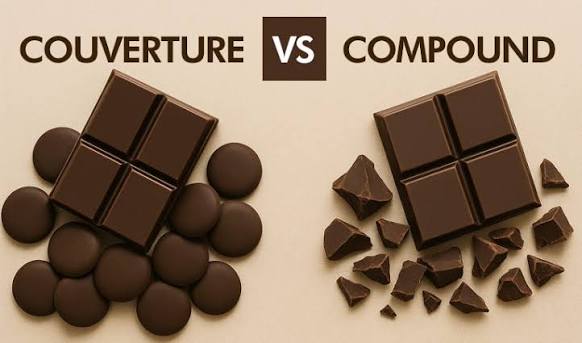
Couverture Chocolate Meaning
Couverture chocolate meaning, in simple terms, refers to a high-grade chocolate made with real cocoa butter as its primary fat, containing no added vegetable fats.
“Couverture” comes from the French word for “covering,” reflecting its traditional use for coating, enrobing, and fine confectionery work.
Because its fat content is entirely cocoa butter, couverture behaves in very specific, predictable ways — but only when handled correctly.
Compound Chocolate Meaning
Compound chocolate meaning refers to chocolate made by replacing some or all of the cocoa butter with vegetable fats, such as palm kernel oil, while combining it with cocoa solids, sugar, and flavouring.
It’s designed to be more forgiving to work with, since it skips the technical step that couverture demands.
This single difference in fat source is the reason every other property — melting, snap, mouthfeel, cost — diverges between the two.
Fat Composition: The Core Difference
This is the root of every other distinction on this list.
| Factor | Couverture | Compound |
|---|---|---|
| Primary fat | Cocoa butter | Vegetable fat (palm, soy, etc.) |
| Cocoa butter content | Typically 31%+ | Little to none |
| Fat behaviour | Crystallises into specific structures | Stabilises without crystallisation |
Cocoa butter is a natural fat that forms multiple crystal structures depending on temperature — which is exactly why couverture needs tempering, and compound doesn’t.
For additional technical information, refer to the FAO/WHO Codex Alimentarius standards for cocoa and chocolate products.
Tempering Requirement
Chocolate tempering is the controlled heating and cooling process that aligns cocoa butter crystals into a stable form (Form V), producing glossy, snap-worthy chocolate.
- Couverture must be tempered. Skipping this step results in dull, streaky, soft chocolate that melts too easily and never sets properly.
- Compound does not require tempering. Its vegetable fat stabilises on its own simply by cooling, which is why it’s the default choice for high-speed, low-skill production.
For bakers learning professional chocolate making, mastering tempering is often the single most technical skill in the entire chocolate module — and the clearest line between hobby-level and professional-level work.
You can also refer to the Codex Committee on Cocoa Products and Chocolate for related chocolate standards.
Melting Behaviour
Couverture melts smoothly and evenly around body temperature (~34°C), which is exactly why it feels like it “melts in your mouth.”
Compound melts at a higher, less precise range, and often melts unevenly — sometimes feeling slightly waxy rather than smooth, since vegetable fats don’t melt the same way cocoa butter does.
Snap and Mouthfeel
Snap
The “snap” — that clean, audible break when you bite into a chocolate piece — is a direct result of proper crystallisation.
- Couverture, when tempered correctly, produces a sharp, clean snap.
- Compound tends to have a softer, duller break, since it lacks the same crystal structure.
Snap is one of the fastest ways an experienced baker can visually and physically judge chocolate quality without lab equipment.
Mouthfeel
Couverture delivers a smooth, silky mouthfeel that dissolves cleanly, largely because cocoa butter melts precisely at body temperature.
Compound can feel slightly greasy or leave a lingering coating on the palate, since its fat doesn’t melt at the same rate or temperature.
This is often the most noticeable difference to an end consumer, even if they can’t explain why.
Cost and Heat Tolerance
Cost
- Couverture is significantly more expensive due to higher cocoa butter content and quality sourcing.
- Compound is considerably cheaper, making it attractive for high-volume, budget-sensitive production.
This cost gap is exactly why compound chocolate remains widely used — not because it’s technically superior, but because it makes commercial sense for certain products.
Heat Tolerance
- Compound holds up far better in warm or humid conditions, since vegetable fats have a higher melting point and are less sensitive to ambient temperature.
- Couverture is more heat-sensitive and can soften or bloom (develop a dull, greyish surface) if stored or transported without temperature control.
This is a major reason many bakeries in warmer climates rely on compound for retail display items that sit out for hours.
Moulding and Professional Applications
Moulding
- Couverture, once tempered, releases cleanly from moulds with a glossy, professional finish — but only if the tempering was done correctly. Poor tempering means the chocolate sticks or looks dull.
- Compound is far more forgiving for moulding. It sets reliably without tempering and releases easily, which is why it’s commonly used for large-scale moulded shapes, novelty items, and quick-turnaround products.
So, Which Chocolate for Baking Should Professionals Use?
There isn’t a single answer — the best chocolate for baking depends entirely on the product:
- Use couverture for premium truffles, ganache, enrobed pastries, plated desserts, and anywhere mouthfeel and appearance are the selling point.
- Use compound for high-volume moulded items, decorations, coatings that need heat stability, or budget-driven products where cost matters more than finish.
Professional bakers don’t choose one chocolate permanently — they choose the right chocolate for each specific application, and that decision only becomes intuitive with hands-on, guided practice.
Where This Skill Fits Into a Baking Career
Chocolate work is one of the clearest examples of why technique-based training matters more than recipe-following.
Understanding compound vs couverture chocolate on paper is one thing — controlling tempering curves, judging crystallisation by feel, and troubleshooting bloom or seizing in real time is another.
This is exactly the kind of skill developed through Celesteyum’s professional chocolate making training, where students work hands-on with both couverture and compound chocolate under guided supervision.
If you are looking for structured professional training that covers baking, pastry, patisserie and confectionery, you can explore Celesteyum Academy’s Advanced Diploma in Professional Patisserie & Confectionery .
For a shorter professional pathway, you can also explore the Short-Term Diploma in Professional Patisserie & Confectionery .
Learn It Hands-On: Master Chef Class, October 30 & 31
If you want to move beyond theory and actually work with couverture, practice chocolate tempering, and understand chocolate behaviour the way professional kitchens do, our Master Chef Class on 30th & 31st October is built exactly for this.
Seats are limited, and this batch is filling up fast given the short window before the class dates.
Reserve your seat now — contact us at +91 81055 12065 / +91 95352 07932 or visit Celesteyum Academy to enrol before seats close.
UPCOMING CLASSES
- Bread Fundamentals Class in Bangalore
September 21, 2026 - Cookies and Brownies Class in Bangalore
September 26, 2026 - Pastry Special Class in Bangalore
September 28, 2026 - Bread Fundamentals Class in Bangalore
October 3, 2026 - Sour Dough Breads Class in Bangalore
October 3, 2026 - Diploma in Professional Patisserie and Confectionery
October 5, 2026 - PIES AND TARTS
October 5, 2026 - Artisan Chocolates Class in Bangalore
October 7, 2026 - Cakes and Pastries Class in Bangalore
October 10, 2026

Shobha Bhat

Founder and Pastry Chef
Celesteyum Academy is the culmination of years of passionate baking and Shobha‘s dedication to teaching the best practices in the world of baking. Coming from a family deeply entrenched in the hospitality industry, her journey into the world of baking began a decade ago.